Suriname’s Bitcoin Loop: From Rainforest to Resilience
A bitcoin grassroots circular economy takes root in the rainforest

Why Read This? (~17 min read)
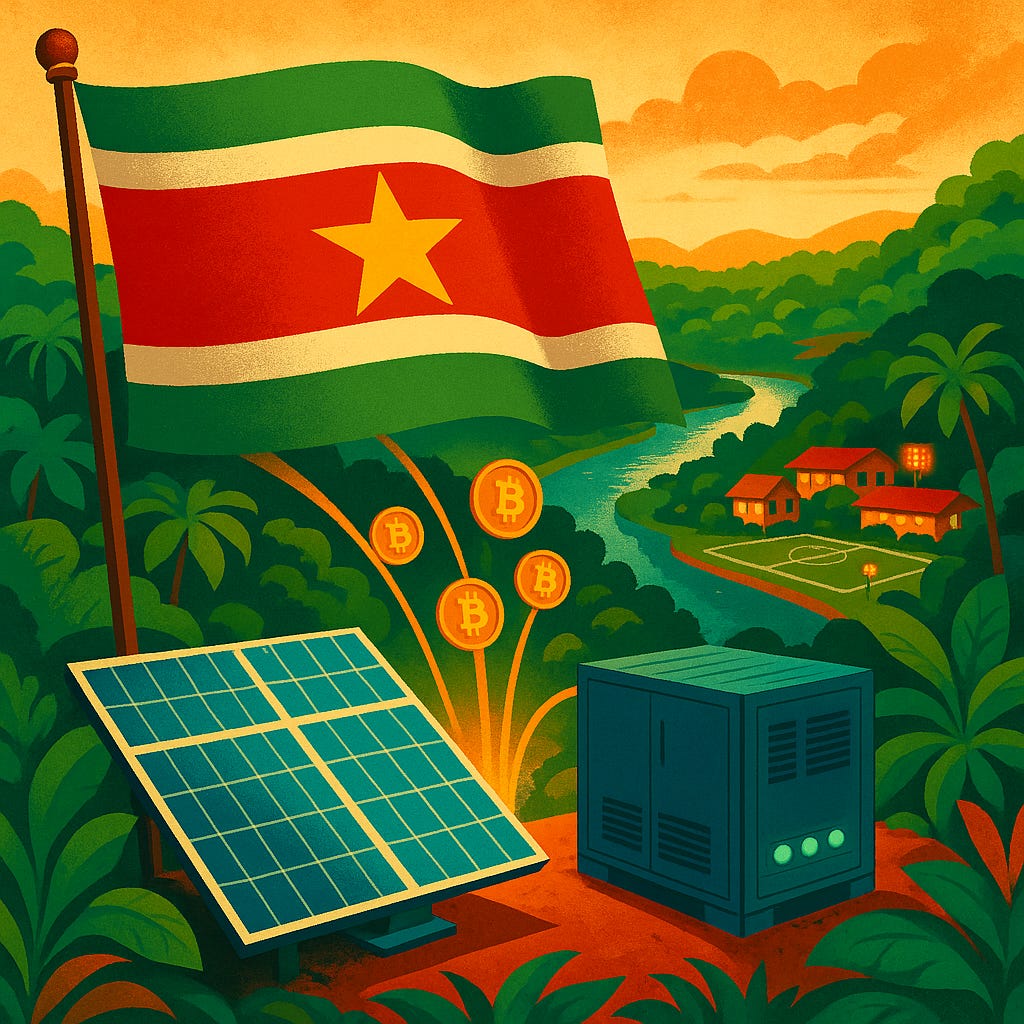
IN THE covered market in Paramaribo, a ceiling fan creaks overhead while Asha counts change for a customer buying cassava bread. Her phone buzzes softly: a Lightning payment has settled. Outside, the afternoon rain drums on corrugated roofs and swells the Suriname River. Far upstream, at the Afobaka dam, turbines continue turning long after domestic demand has fallen away, spilling surplus hydropower into the night.
A small but growing share of that wasted energy is already being captured not in vast server farms, but in modest community treasuries measured in satoshis. Football jerseys for village youth teams, floodlights for evening training sessions, meals for orphanages: all are now routinely paid for in Bitcoin. For merchants and families who watched the Surinamese dollar lose nearly 500 % of its purchasing power between 2020 and 2024, converting watts into cryptocurrency is not ideology. It is groceries, rent, survival.
“Every goal shines brighter under lights paid for with sats,” says a local coach who no longer begs the ministry for funds that never arrive.
Featured stack: Services — Sazmining, Blink Wallet, Tools — BTCPay Server, LNbits, Protocols — Bitcoin, Lightning
A Small Country, Large Pressures
Suriname, population 626,000, sits on South America’s northern shoulder, 93 % blanketed by rainforest. Most citizens live along a narrow, flood-prone coastal strip, sustained by an economy worth $3bn–4bn built on gold, bauxite and, soon, offshore oil. Public debt stands at 117–129 % of GDP; the IMF’s latest $690m programme concluded in March 2025. Inflation, which topped 50 % a year in 2021–2023, has cooled to around 16 %, yet a quarter of adults remain unbanked or underbanked. When the local currency melts and the nearest bank branch is an expensive taxi ride away, Bitcoin’s rails begin to look like infrastructure.
Some of that potential already leaks into the real world. A trickle of sats pays for youth football jerseys and field lights through community treasuries. Others settle in Asha’s ledger as a buffer against a currency that refuses to stay still. After inflation spiked over 50% annually from 2021–2023 and a cumulative 476% between 2020–2024 “watts-to-sats” isn’t ideology. It’s food, rent, survival.
The Circuit, Explained
The Surinamese model deliberately avoids the theatrics of legal-tender laws. Instead it relies on a simple, replicable circuit:
Expatriates, tourists and foreign supporters send small donations via Lightning or contribute to public wallets.
Community treasuries—sports clubs, soup kitchens, youth programmes—receive the funds transparently.
Merchants accept Lightning for everyday goods; families swap surplus cryptocurrency for SRD or dollars via over-the-counter brokers or QR codes at the market.
Monthly on-chain and Lightning reports, complete with public addresses, maintain trust.
The circuit is modest perhaps 125–150 merchants as of late 2025 but it is compounding. Blink Wallet registrations in Suriname rose 2,389 % between July 2024 and March 2025. Four Bitcoin ATMs have operated since early 2025; point-of-sale systems are scheduled for wider rollout in January 2026.
The Builder at the Centre
Maya Parbhoe founded Bitcoin Sranan in 2022 after studying El Salvador’s experiment, but rejected top-down imitation. She co-founded Daedalus Labs to develop open-source Bitcoin and Nostr tools, lobbied the president and central bank alongside advisers such as Samson Mow, and in 2024 ran for parliament on a platform of Bitcoin reserves, cryptocurrency-denominated civil-service bonuses and transparent public treasuries.
The campaign ended in defeat in May 2025, shortly after she gave birth and while still recovering from complications. Weeks earlier, Geyser Fund a major crowdfunded grant platform abruptly delisted Bitcoin Sranan’s projects, forcing the closure of a food kitchen that had fed dozens daily. A hostile article in Bitcoin Magazine deepened the damage. Yet Ms Parbhoe rebuilt through fixed monthly meetups on the 21st, “Fruits for Sats” workshops for orphans, and patient merchant onboarding in Paramaribo’s malls.
Hydro Meets Bitcoin
Suriname’s grid is predominantly hydroelectric, with the 189 MW Afobaka dam supplying around 60 % of electricity. At night, surplus power is simply curtailed. Small, containerised mining rigs 2–3 MW in total could be deployed with almost no incremental emissions could instead convert that waste into cryptocurrency flowing directly to audited community wallets. Bhutan has mined roughly 13 BTC a month since 2023 using similar logic; Laos is attempting the same for debt relief.
The catch, so far, is funding. Grant proposals for the past two years have insisted on public energy-purchase agreements, automatic curtailment triggers during shortages, and fully auditable conversion of electricity into Bitcoin. Those conditions have deterred some investors and one opaque ≈2 MW facility near Paranam has already provoked accusations of cronyism. The lesson is clear: in a country with a long history of resource-curse politics, secrecy is fatal. Sunlight is the only acceptable disinfectant.
Sceptics and Safeguards
Not everyone is convinced. The IMF has warned that widespread crypto adoption in small economies can weaken policy options and amplify capital outflows during shocks. Locally, the Central Bank of Suriname stresses that it “cannot vouch for cryptocurrency transactions” and highlights risks of volatility and fraud.
Yet Suriname’s grassroots approach, with its insistence on transparency, small-scale pilots and community audits, appears crafted to contain precisely those dangers. Monetary policy remains untouched; adoption is voluntary and incremental. For a nation already battered by inflation and debt, the upside resilience without fresh external bailouts may outweigh the hazards.
Two Paths Diverge in the Rainforest
El Salvador chose the palace: a legal-tender law, geothermal megaprojects, and a national wallet pushed by presidential decree. Suriname is choosing the market stall and the village football pitch: treasuries first, merchant rails first, voluntary adoption anchored in radical transparency. One model is politically brittle; the other is antifragile.
What 2026 Could Bring
Return in twelve months and the map of Lightning merchants may exceed 200. Community treasuries clinics, clubs, school lunch programmes will publish monthly reports as a matter of course. Energy dashboards will prove that miners sip only surplus juice and shut down the moment the grid tightens. A Bitcoin Education Centre, delayed by the setbacks of 2025, should at last be open. And the first small, fully audited hydro-to-Bitcoin pilot may finally be humming.
Suriname is not trying to become the next Dubai or San Salvador. It is attempting something quieter and potentially more durable: showing that a small, indebted, rainforest nation can build monetary resilience from the ground up—one honest satoshi, one public wallet, one surplus kilowatt at a time.
To support the circuit: send donations to BitcoinSranan@Blink.sv
To join it in person: Suriname Decentralized Conference, Paramaribo, March 2026—workshops, merchant onboarding, and rainforest air included.
The rails are being laid. They are meant to last.
“In a world of debt and volatility, a small rainforest nation models free, regenerative money—one honest sat at a time.”